
Reaching the “All But Dissertation” (ABD) stage is one of the most bittersweet moments in a student’s life. You’ve climbed the mountain of coursework, survived the grueling comprehensive exams, and successfully defended your proposal. You are officially a “Doctoral Candidate.” However, for many in the United States, this is where the momentum stalls. Without the weekly structure of a classroom or the pressure of a looming mid-term, the dissertation becomes a vast, open-ended project that can feel impossible to finish.
According to various educational studies, nearly 50% of doctoral students in the US remain in the ABD phase for years, sometimes never finishing at all. This “doctoral burnout” often stems from isolation and a lack of clear project management. To move forward, you need to stop thinking like a student and start thinking like a professional researcher. While the intellectual work is yours alone, many successful candidates find that utilizing high-level dissertation writing services through reputable platforms like myassignmenthelp can provide the essential structural editing and proofreading needed to turn a rough draft into a defense-ready manuscript.
The Psychology of the “ABD” Trap
Before we dive into the strategies, it is important to understand why people get stuck. In high school and undergraduate studies, you are rewarded for following a syllabus. In a PhD or DBA program, you have to create the syllabus. This shift in mindset is the biggest hurdle. The following five strategies are designed to help you regain control of your schedule, your writing, and your path to graduation.
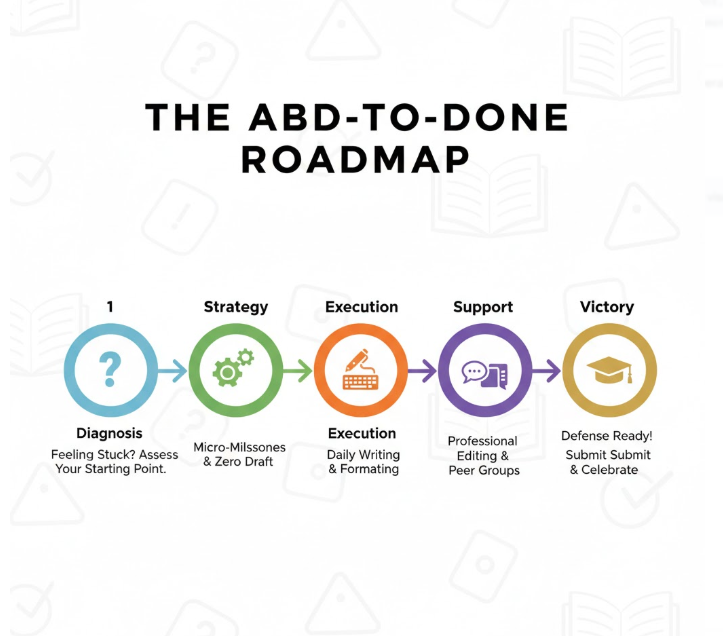
1. The Power of “Micro-Milestones”
When you look at a dissertation as a 200-page book, your brain naturally goes into a “fight or flight” response. It is too big to process. The most successful candidates break their work down into “micro-milestones.”
Instead of saying, “I will work on Chapter 4 this week,” tell yourself, “I will write the three paragraphs explaining my data collection tools on Monday.” By narrowing your focus, you prevent the paralyzing feeling of being overwhelmed.
Pro-Tip: Create a “Done List” instead of just a “To-Do List.” Every time you finish a page or even a bibliography entry, write it down. Seeing your progress visually is a powerful motivator for the long haul.
2. Embrace the “Zero Draft” Concept
Perfectionism is the enemy of completion. Many students spend three weeks trying to write the “perfect” introductory paragraph for their Literature Review. The problem is that your ideas will evolve as you write. That perfect paragraph will likely need to be changed anyway.
The “Zero Draft” (also known as the “Ugly First Draft”) is about getting your thoughts onto the paper without judging them. Do not worry about grammar, flow, or sophisticated vocabulary in the first pass.
- Write in bullet points if you have to.
- Leave placeholders like “[Insert more evidence here]” when you get stuck.
- Keep the momentum going.
Once you have 20 pages of “ugly” text, you have something to work with. It is much easier to edit a bad page than it is to edit a blank page.
3. Mastering the “US Academic Standard” (APA 7th Edition)
In the United States, your dissertation isn’t just judged on your ideas; it is judged on your precision. Most social science and education programs require strict adherence to the APA 7th Edition formatting style.
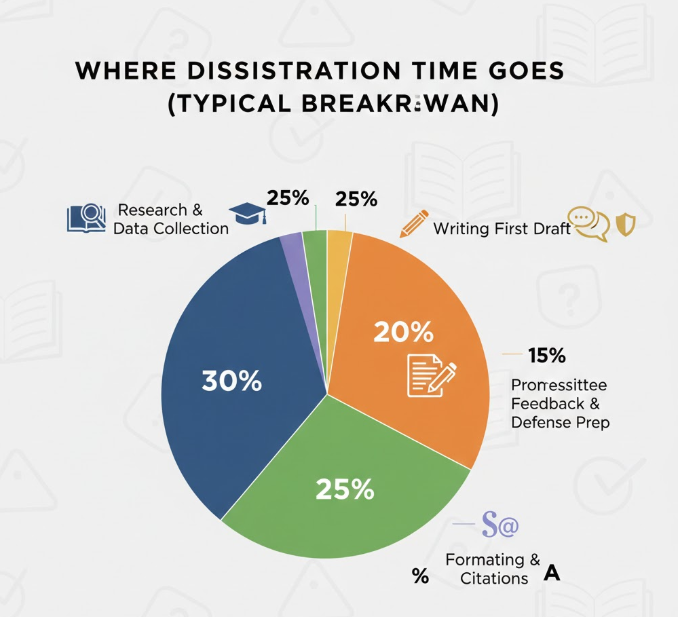
If you wait until the very end to fix your citations, you will find yourself in “formatting hell.” You might spend 40 hours just checking commas and italics in your reference list. To avoid this:
- Use a Citation Manager: Tools like Zotero or EndNote are life-savers.
- Format as You Go: Set your Microsoft Word or Google Docs styles (margins, font, and page numbers) before you write the first word.
- Check the Rubric: Every university has a specific “Dissertation Handbook.” Keep it open on your desk at all times.
4. Navigating the Data Analysis Phase
For many, the most terrifying part of the dissertation is the “Results” or “Findings” chapter. This is where you have to prove your hypothesis using complex statistics or qualitative coding. This is especially true for business students who are often balancing high-pressure jobs while finishing their degrees. If you find yourself stuck on the technicalities of data presentation, looking into MBA Dissertation Writing Services at myassignmenthelp can offer the expert guidance needed to ensure your data analysis meets the rigorous standards of a graduate committee.
5. “Managing Up” Your Dissertation Committee
Your committee members are not your bosses; they are your consultants. However, they are often incredibly busy professors with dozens of other students. If you wait for them to reach out to you, you might wait forever.
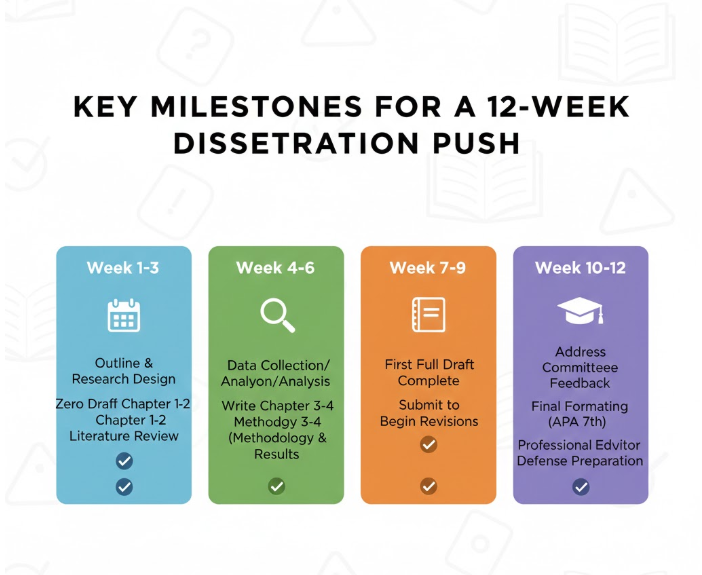
To finish your degree, you must “manage up.” This means being proactive and professional:
- Send Regular Updates: Every two weeks, send a short email to your Chair. “Hi Dr. Smith, I’ve completed the draft of Section 3.2 and I am currently working on the data tables. I expect to send you the full chapter by next Friday.”
- Ask Specific Questions: Never send a chapter and ask, “What do you think?” Instead, ask, “Does my argument in the Methodology section clearly justify the use of a case study?”
- Handle Feedback with Grace: Your committee will give you “corrections.” Don’t take them personally. See them as a checklist. Every correction you finish is one step closer to the “Doctor” title.
Why E-E-A-T Matters in Research
When you are writing your dissertation, Google and the academic community look for Experience, Expertise, Authoritativeness, and Trustworthiness (E-E-A-T). You demonstrate this by:
- Citing Peer-Reviewed Sources: Only use journals that are recognized in your field.
- Transparency: Be honest about the limitations of your study. No research is perfect.
- Consistency: Ensure your tone remains professional and academic throughout the entire 100+ pages.
Summary Table: The Path from ABD to PhD
| Phase | Common Challenge | Winning Strategy |
| Drafting | Writer’s Block | Use the “Zero Draft” method; just get words on paper. |
| Formatting | APA/MLA Compliance | Format from day one; use citation software. |
| Data Analysis | Technical Complexity | Seek expert consultancy for data visualization. |
| Review | Slow Committee Feedback | “Manage Up” with proactive, weekly check-ins. |
| Final Polish | Burnout | Professional editing to ensure the tone is “defense-ready.” |
Frequently Asked Questions (FAQ)
Q: How many hours a day should I work on my dissertation?
A: Consistency is more important than quantity. Working for 2 hours every single day is much more effective than trying to do a 14-hour “marathon” on Saturdays.
Q: Is it okay to use an editor?
A: Yes. In fact, most US universities encourage students to use professional editors for grammar and formatting. As long as the research, data, and original thoughts are yours, having a professional “clean up” the language is a sign of a serious scholar.
Q: What if my committee members disagree with each other?
A: This is common! When this happens, schedule a joint meeting or ask your Chair to make the final decision. You shouldn’t be caught in the middle of a faculty disagreement.
Q: How do I stay motivated when I feel like quitting?
A: Remind yourself why you started. Think about the career opportunities, the “Doctor” title, and the fact that you are contributing something new to the world’s knowledge. You’ve come too far to only come this far.
Final Thoughts for the ABD Candidate
The difference between a student and a Doctor is simply persistence. The dissertation is not an IQ test; it is an endurance test. It is about waking up when you are tired, writing when you don’t feel inspired, and being brave enough to ask for help when the workload becomes too heavy.
By utilizing structured deadlines, embracing the “ugly” first draft, and leaning on professional resources for formatting and editing, you can finally close this chapter of your life. You are closer than you think. Now, open that document and write the next 500 words.
About the Author:
Dr. Aris Thorne is a senior academic consultant and researcher specializing in US higher education success. With over 12 years of experience in dissertation mentoring and thesis defense preparation, Dr. Thorne helps doctoral candidates overcome the “ABD” hurdle. As a key strategist for myassignmenthelp, they provide expert guidance on academic structuring and professional research editing to help students achieve their graduation goals.