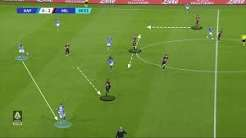

In Ligue 1 2017/2018, several teams tried to build patiently around the edge of the box instead of attacking quickly, and that choice had a direct impact on how often they were exposed to counter-attacks. The more a team compressed play into the final third with short passes and positional rotations, the more it had to manage the transition risk that came every time possession was lost in crowded central areas.
Why Working the Ball Around the Box Is Both an Advantage and a Liability
Circulating the ball around the penalty area is attractive because it lets teams search for high-quality chances, drag defenders out of position, and maintain territorial pressure. Analyses of possession play in European football show that the key is not possession itself but where it happens and how quickly the ball moves between lines, which is exactly what these Ligue 1 sides tried to control in 2017/2018. The trade-off is that when many players push high and central to support these short combinations, any turnover immediately creates space behind the midfield and full-backs, inviting opponents to launch direct counters into those open channels.
Which 2017/2018 Team Profiles Favoured Box-Edge Possession
Even without a complete public ranking broken down by “passes in the final third” for 2017/2018, we can infer which Ligue 1 teams preferred patient construction near the box by looking at broader possession and performance patterns. Over that season, PSG dominated with high possession and heavy attacking output, while clubs like Lyon and Marseille were also known for technical, forward-minded play rather than pure direct football. These sides used structured positional attacks—similar in principle to the broader European trends described in possession research—to circulate the ball around the area, seeking gaps and cutback lanes instead of relying mainly on early crosses or long balls.
Mechanism: From Edge-of-Box Combinations to Being Hit on the Break
When a team stacks players around the opponent’s box, it does so to create overloads and shooting windows, but those same positions define the shape of its defensive transition. Typically, full-backs are high, one or two midfielders step beyond the ball, and centre-backs hold a wide starting position to recycle possession; if the ball is lost, the nearest players must counter-press immediately or the opponent can break into space before the team can reset. In 2017/2018 Ligue 1, sides that executed this transition poorly—slow reactions, weak rest defence structures, or large gaps between their last line and midfield—turned their box-edge passing into a trap, repeatedly conceding counters where one or two vertical balls bypassed multiple players still recovering from attacking positions.
How Different Possession Styles Around the Box Affected Counter Risk
Not every team that liked to combine near the box carried the same level of counter-attack exposure; subtle tactical differences mattered. Some teams maintained a strong “rest defence” with a holding midfielder screening counter lanes and full-backs rotating cautiously, while others committed both full-backs and several midfielders high simultaneously, betting that sustained pressure would produce a goal before a turnover punished them.
Comparison of controlled vs exposed box-edge possession
In broad terms, “controlled” box-edge possession in Ligue 1 2017/2018 meant having compact distances between players and clear counter-pressing triggers, which allowed teams to smother many counters at source when moves broke down. More “exposed” versions of the same idea saw long, slow spells of passing without vertical penetration, then risky attempts to force the final ball with too many players beyond the line of the ball; those sides were more likely to concede transitions ending in shots from relatively few opposition passes, a pattern that systematic counter-attack studies in other leagues have also highlighted.
Table: Stylised 2017/2018 Team Types, Box-Edge Play, and Counter Threat
Because season-specific micro data are scattered across specialist databases, a stylised view helps connect playing style to counter-attack likelihood in a practical way.
| Team type in 2017/2018 | Box-edge possession behaviour | Typical counter-attack risk pattern |
| Elite positional attack side | High central presence, structured rest defence | Fewer counters allowed, but dangerous when they occur |
| Technical mid-table team | Frequent short combinations, less disciplined cover | Regular medium-length counters conceded |
| Over-ambitious lower-ranked side | Occasional long spells near box, poor spacing | High risk: few passes by opponent to reach shooting zones |
This structure shows that the same “love of passing around the box” can have very different outcomes depending on how the rest of the team is arranged. In 2017/2018, stronger Ligue 1 teams could compensate with better organisation and counter-pressing, while some mid- and lower-table sides saw their attempts at patient play turned into fuel for opponents’ fast breaks, particularly against more athletic or tactically sharp counter-attacking teams.
Where UFABET Fits Into Reading Counter-Attack Risk from Box-Edge Play
Once you have a clear picture of which teams’ 2017/2018 attacks revolved around patient combinations near the area and how reliably they defended transitions, the question becomes where to express those insights in markets. In a scenario where a bettor has already concluded that a specific matchup is likely to produce clear counter opportunities—for example, a technical, box-edge-focused side facing a compact, fast-breaking opponent—the logical step is to examine prices for related outcomes: both teams to score, over/under on shots for the counter-attacking side, or even time-of-first-goal props. If, after that analysis, you then find that a betting platform such as ufa168 offers lines on those outcomes that appear out of step with the expected counter dynamics derived from 2017/2018 patterns, the service becomes a channel for implementing a view already grounded in playing style rather than a starting point that shapes your thinking.
Practical List: Indicators That a Box-Edge Team Is About to Be Countered
To move beyond abstract theory, you can use a checklist that links observable behaviours during a Ligue 1 2017/2018 match to elevated counter-attack risk. Even when watching highlights or replays, these indicators help you assess, in real time or retrospectively, whether a team’s box-edge passing is under control or on the verge of being punished.
- The attacking side frequently has both full-backs beyond the ball when circulating around the box, leaving only two centre-backs and perhaps a single pivot to guard transitions.
- Possession spells near the area are long and lateral, with slow ball speed, giving opponents time to stay compact while also positioning runners for a breakout once they win the ball.
- On turnovers, you repeatedly see large gaps between the attacking team’s last line and its midfield, forcing desperate recovery sprints rather than coordinated counter-pressing.
- The opponent has at least one forward or winger consistently hovering near the halfway line instead of dropping fully into the block, clearly positioned to launch onto any loose ball.
When several of these conditions hold, the probability that box-edge combinations will produce clear counter chances increases, especially if the possession team insists on continuing the same patterns instead of adjusting their rest defence. That shift in probabilities can, over many similar scenarios, justify more confidence in markets that benefit from fast-break goals or high-quality chances for the nominally “less dominant” side, even if overall possession numbers remain heavily in favour of the patient team.
Separating Tactical Counter Understanding from casino online Habits
Counter-attacks are emotionally charged moments, and it is easy for their drama to blur into the thrill-seeking mindset associated with other, more volatile forms of gambling. When analysis of Ligue 1 2017/2018 box-edge possession and transition risk sits alongside much faster, luck-driven activities, there is a temptation to view every counter as a spin of the wheel rather than as a product of repeated structural conditions. Keeping your reading of possession-versus-counter dynamics as a distinct, evidence-based approach—evaluated against long-run results and match patterns—while treating any time spent in a casino online website as separate recreation helps maintain clarity. That separation lets you judge whether your understanding of how and when box-edge play invites counters is genuinely improving your probabilistic decisions, instead of just providing narrative justification after the fact.
Summary
In Ligue 1 2017/2018, teams that enjoyed working the ball around the edge of the box lived with a constant trade-off: they gained control of chance creation but increased their exposure to counter-attacks whenever their rest defence and counter-pressing were not perfectly aligned. Elite sides with strong structures could use box-edge possession as both an attacking tool and a defensive shield, but more fragile teams often saw their slow, lateral combinations turn into invitations for direct breaks that bypassed half their players in a few passes. For analysts and bettors, recognising which version of this style a team belongs to—and spotting in-match indicators that the balance has tipped toward danger—provides a more grounded way to think about fast-break goals and market opportunities tied to them than simply reacting to the spectacle of a single end-to-end move.